
Common Reasons for DNA Tests
People choose DNA testing for several personal, legal, and medical reasons. These include:
- Peace of Mind: Eliminating doubts regarding biological family relationships for personal and emotional clarity.
- Organ Transplantation: The Transplantation of Human Organs and Tissues Act (THOTA), 1994, and applicable rules require documentation of the donor-recipient relationship in specified cases. DNA testing may help establish biological relationships when required.
- Sponsored Immigration: Confirms the biological family connection between the sponsor and the applicant when requested by immigration authorities.
- Family Origins: Discover where your ancestors came from and potentially identify distant relatives.
- Non-Invasive Prenatal Paternity: Helps establish the biological relationship between an unborn child and an alleged father using a maternal blood sample and the alleged father’s DNA sample. It does not involve fetal sex determination.
Steps of the DNA Testing Procedure
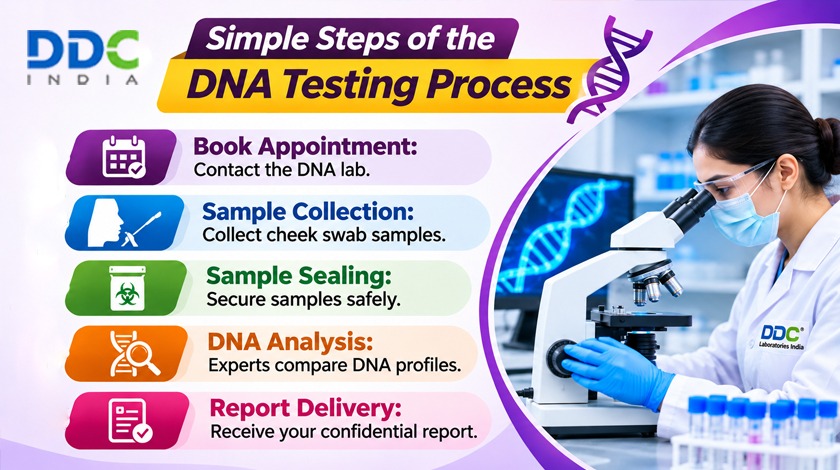
- First, the interested party contacts the experts at DDC Laboratories India and schedules an appointment for DNA sample collection.
- A trained professional collects DNA samples from the individuals by rubbing a soft cotton swab against the inside of their cheeks. It is a non-invasive and generally painless procedure.
- The collected DNA samples are securely sealed in tamper-evident packaging and sent to the laboratory for further analysis.
- Laboratory experts examine and compare the DNA samples to determine the potential genetic relationship between the individuals.
- After completing the DNA analysis, a final report is generated and delivered according to the agreed testing and reporting procedure.
A cheek swab is the first choice for most relationship tests. Hair with suitable roots, nail clippings, or body tissue may also be considered in specific cases, but the laboratory must first assess whether the sample is suitable for testing.
The Chain of Custody Procedure in DNA Tests
For official procedures, such as embassy applications or court-related disputes, a DNA test may be performed under a strict chain of custody procedure.
During this procedure, an authorized collection official monitors the testing process, from identity verification and sample collection to secure sealing and transportation in tamper-evident packaging. Before sample collection, the identities of the individuals being tested are verified using their government-issued identification documents.
The final report is then submitted according to the instructions of the requesting authority, such as an embassy or court. Depending on the official requirements, the report may be sent directly to the requesting authority rather than to the tested individuals.
Factors Affecting the Cost of DNA Tests
The DNA test cost in Ahmedabad, as in other cities across India, depends on several factors. The main factors include:
1. Type of the Test
A peace-of-mind DNA test generally costs less because it involves sample collection and laboratory analysis without additional legal formalities. An official DNA test, on the other hand, may cost more because it involves identity verification, documentation, witnessed sample collection, and chain of custody procedures. These tests are commonly required for embassy or court purposes.
2. Number of People in the Test
A DNA test usually involves two individuals, but adding a third person can increase the overall cost. For instance, a maternity test generally involves a mother and child. However, if an additional child is included, the laboratory may charge more for the additional analysis.
3. Express Delivery of the Report
Some individuals need their DNA test reports urgently. An express delivery option may be available for peace-of-mind DNA tests at an additional cost. Depending on the test and laboratory schedule, reports may be delivered within 24–48 hours. The typical turnaround time is approximately 4–5 business days.
Why Choose DDC Laboratories India?
Not every laboratory provides DNA reports suitable for official purposes. A report from a laboratory that does not meet the requirements of the requesting authority may be rejected, potentially wasting your time and money. That is why it is important to check a laboratory’s accreditations and the specific acceptance requirements before scheduling an appointment.
DDC Laboratories India holds accreditations and recognitions including NABL, NATA, AABB, IRCC, and MOJ. Our DNA testing services support both personal and official requirements, subject to the applicable accreditation scope and the requirements of the requesting authority.
Our DNA reports may be used for immigration-related cases involving international authorities, including those in the United States, the United Kingdom, Canada, and Australia, when the relevant authority accepts the laboratory and testing procedure.
Moreover, we have more than 250 sample collection centers across the globe, making it easier for individuals to find a testing facility near their location. Our trained professionals help make the DNA sample collection process convenient and straightforward.
Book a DNA Test in Ahmedabad
For more information or to book an appointment for a DNA test in Ahmedabad, contact DDC Laboratories India:
Phone: +91 8010177771
WhatsApp: +91 9266615552
Frequently Asked Questions
Q1 How to order a DNA test online in India?
Contact the experts at DDC Laboratories India to order a DNA test kit online. You can also visit the official website to enquire about available testing services and kit ordering options.
Q2 How accurate are at-home ancestry testing kits?
At-home ancestry DNA kits can provide reliable genetic information when samples are collected and processed correctly. However, accuracy depends on the type of analysis, laboratory methods, and the specific ancestry estimates or relationships being examined. A universal accuracy percentage does not apply to every ancestry test.
Q3 What documents are needed for a DNA test in India?
Depending on the type of DNA test, you may need a government-issued identity document, recent photographs, and a signed consent form. Official tests may require additional documentation and identity verification.
Q4 How do I book an immigration DNA test at an accredited lab in India?
Contact the laboratory experts at DDC Laboratories India to enquire about an immigration DNA test. They can guide you through the appointment, identity verification, sample collection, and reporting requirements based on the requesting embassy’s instructions.
Q5 What are the different types of DNA testing services available in India?
Paternity, maternity, siblingship, avuncular, grandparentage, DNA profiling, cell line authentication, non-invasive prenatal paternity, organ transplantation, ancestry, etc. are some of the DNA testing services available in India.
Q6 How long does it take to get results from a DNA test?
At DDC Laboratories India, the typical turnaround time for a DNA test report is approximately 4–5 business days. Express reporting may also be available for eligible peace-of-mind DNA tests, including same-day or next-day options at an additional cost.
Q7 Can I do DNA testing at home and send samples by post?
Yes. Some DNA testing services offer home collection kits that allow you to collect cheek swab samples yourself and return them to the laboratory using the provided shipping instructions. However, official DNA tests generally require supervised sample collection and identity verification under a chain of custody procedure.

