
When you need to confirm a biological relationship, you often look for the most reliable method available. In the labs, a simple mouth swab is the first choice for collecting the DNA samples. However, there are times when a different approach is necessary due to the health or location of the person being tested.
In these specific cases, a hair DNA test serves as a vital tool for providing the answers you seek. This method uses the biological information stored in your hair follicles to find the accurate genetic link information.
Also Read:Buccal Swab DNA Test
How Is Biological Information Stored in Hair?
Your hair is not just a simple strand; it is a complex structure that holds a lot of information about your genetic code. The lab experts look at two main parts of hair to find the information regarding the unique genetic code.
The first part is the shaft, which is the long part of the hair you see on your head. The second part is the root, also called the follicle. It’s a tiny, white bulb-like appearance at the bottom of the hair strand.
For a standard relationship test, the hair root is the most important part of hair testing. This is because the root contains genetic markers, which a person inherited from both their mother and father.
If you only have the hair shaft, the lab can only look at mitochondrial DNA, also called mtDNA. This genetic code is passed from a mother to all of her children. While this is sufficient for confirming maternity, it cannot prove paternity.
For this reason, the lab requires a hair sample that still has the root attached when you are looking for a complete hair DNA test result.
Different Situations Where a Hair Analysis is Utilized
Whether you are looking for a parent, a sibling, or a more distant relative, a hair DNA test is also a trusted way to confirm biological connections in situations like:
- Paternity and Maternity: It’s the most common type of DNA test, utilized by many families for their peace of mind, knowing that their child is biologically related to them. In most cases, it’s just for emotional clarity, but it can also be utilized for official reasons.
- Siblingship Testing: Sometimes, siblings have doubts regarding their biological connections. For instance, they may have doubts whether they biologically share both parents, only one, or none.
- Grandparentage and Avuncular Tests: You can also use this to confirm if you are biologically related to a grandparent, an aunt, or an uncle. This is very helpful for families trying to complete their family tree or for inheritance matters.
- Immigration Needs: In some cases, the embassy may request a DNA test to confirm whether the sponsor and applicant are truly family-related. It happens when the primary visa documents fail to prove their family ties or immigration officials suspect the visa documents.
Simple Steps for Collecting the Hair Samples
The following methods can help in obtaining the hair sample for the DNA testing procedure:
Step 1 – Preparation: Wash your hands thoroughly with soap and water, ensuring no oils or dust from your hands contaminates the hair DNA sample.
Step 2 – Selection: You need to pull a fresh hair directly from the scalp. Do not use hair that has fallen out naturally or hair from a comb, as such samples often lack the hair root.
Step 3 – Quantity: Collect at least 7 to 10 strands of hair. Having more strands improves the accuracy of the test in the lab.
Step 4 – Storage: Place the hair stands immediately into a clean, dry paper envelope. Do not use plastic bags, as they can trap moisture and cause the hair to break down.
Step 5 – Labeling & Transportation: Write your name, the date, and your relationship to the other person on the envelope, and send it to the lab for further analysis.
Step 5 – Lab Analysis: Once your envelope arrives at the lab, it goes through a very careful process. The experts use specialized tools to look at the hair roots and extract your unique code. They then compare this code to the code of the other person being tested. They look for matching patterns that are only found in family members.
Also Read:Twin DNA tests in India
Personal vs Legal DNA Testing Procedure
Before you start, you need to decide what you plan to do with the results. There are two main ways the lab can handle your request, depending on your needs.
Personal DNA Test
This is for your own personal knowledge. You can collect the samples yourself at home and mail them to the lab. The results are kept completely private and are meant only for you to know the truth about your family. It is a quick and easy way to resolve any doubts you might have.
Legal DNA Testing
If you need to use the DNA results for a court case, such as a birth certificate change or child custody, a chain of custody procedure is utilized. This means a neutral professional must collect the hair strands and confirm the identity of everyone involved. This ensures that no one can claim the samples were switched or tampered with. Even though the technical analysis of a hair DNA test is the same, the way it is collected makes it an official document.
Why Choose DDC Laboratories India for Hair DNA Test?
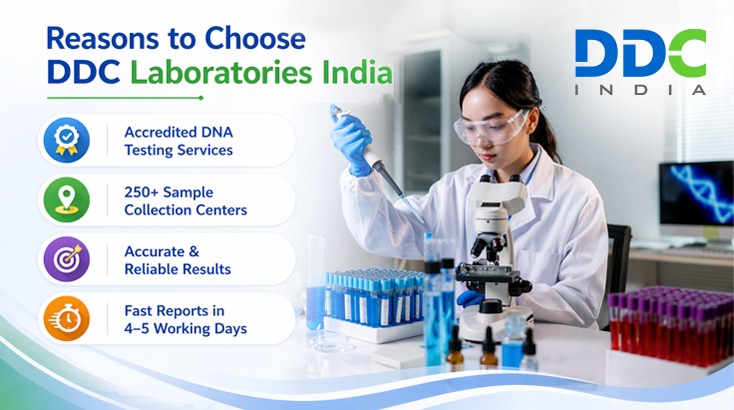
DDC Laboratories India is one of the most reliable DNA testing labs in India. We hold accreditations from NATA, IRCC, MOJ, and AABB, demonstrating the high international standards of our DNA testing facilities. With such accreditations, our DNA reports are admissible for personal as well as official use cases.
We provide DNA testing services for peace of mind, sponsored immigration, hair DNA test, non-invasive prenatal paternity, cell line authentication, etc. Besides, we have over 250 sample center collections across the globe, making it easier for you to find one of our facilities near your location.
The lab experts ensure that every DNA sample is handled with extreme care and precision. These certifications are your guarantee that the answers you receive are based on facts and professional analysis.
For more information or to book a hair DNA test, call us at +91 8010177771. Alternatively, you can also send a message on WhatsApp at +91 9266615552.
Read More: Legal Procedures For a DNA Test in India
Frequently Asked Questions
Q1. How long does a hair DNA test take?
Ans. It usually takes around a minute, as the experts will pull a few hair strands along with their roots. Moreover, the final report will take around 4-5 business days to arrive.
Q2. How much does a hair DNA test cost?
Ans. A hair DNA test costs around 17,000 INR for a single person. However, depending on the type and complexity of the test, the cost may vary.
Q3. Where can I buy a reliable hair DNA test kit online?
Ans. Call the experts at DDC Laboratories India and order a hair DNA test kit online.
Q4. How accurate are hair DNA tests for ancestry information?
Ans. A hair DNA test provides 99% accurate results regarding ancestry as well as genetic information.

