
DNA testing is no longer a topic of scientific studies or a forensic investigation. With growing popularity in different areas, getting a DNA test is easy and affordable as well. Moreover, understanding modern DNA testing is easier than ever and helps you choose from a wide range of services available for your specific needs.
Many people come across different test names and get confused about their purpose. The most common confusion is about the terminology and the difference between a DNA test and an autosomal dna test, because both terms often appear together. As an individual, you might also be interested in a simple explanation of these, so you can better choose the one that best suits your needs.
DDC Laboratories India has seen this confusion among clients for years. With over ten years of experience in peace-of-mind, ancestry, cell line authentication, and immigration DNA tests, they deal with people who simply want answers. To help you make an informed decision, this guide explains the basics of autosomal DNA testing, its uses, and how it compares to a standard DNA test.
Understanding the Autosomal DNA Test and What It Looks at
An autosomal DNA test examines the 22 pairs of non-sex chromosomes. These chromosomes come from both parents. This makes it ideal for familial relationship testing, as it covers both sides of the family and provides a wider genetic overview.
Most people choose an autosomal DNA test when they want to clear a doubt about, or establish a biological relationship. It is commonly used for paternity, maternity, siblingship, grandparentage, and even extended relationships. Since the test looks at thousands of markers, the results are very accurate and easy for the lab to interpret.
An autosomal test is also used for ancestry studies. People often want to learn which regions their ancestors came from. The test gives ethnicity estimates by comparing your DNA with global population groups.
At DDC Laboratories India, we use validated testing technology for:
- Peace-of-mind tests for relationship confirmation
- Sponsor-applicant relationship testing for immigration cases
- Ancestry and paternal, maternal lineage tests to trace the ancestral roots
- Cell line authentication for academic institutions, biotech companies, pharmaceutical and vaccine development sectors, etc.
The Difference Between ‘a DNA Test’ and an ‘Autosomal DNA Test’
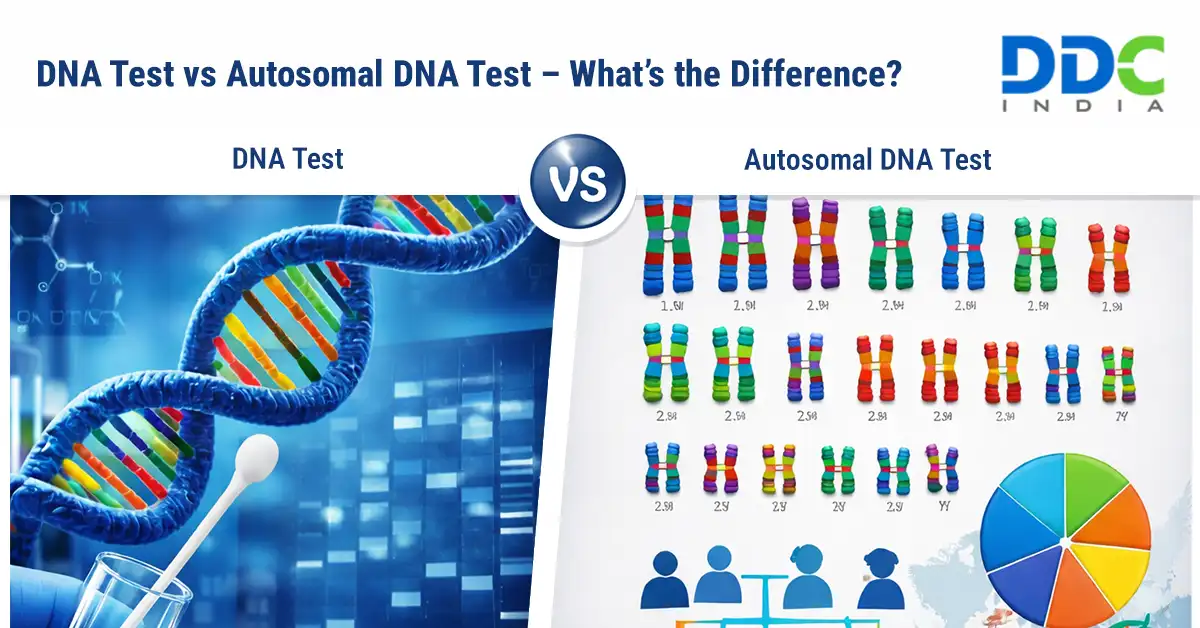
The term DNA test is broad. It includes every type of genetic test used for identification or relationship analysis, like:
- Y-chromosome tests
- mtDNA or mitochondrial DNA tests
- Forensic DNA tests
- Ancestry tests, and more.
However, an autosomal DNA test is a specific category under this wide umbrella. It focuses only on autosomal chromosomes, done to confirm the genetic relationship between two or more individuals.
The confusion about both terms is prevalent, and the answer is as easy as:
- A DNA test is a general term.
- An autosomal DNA test is one type of test within that category.
Knowing this difference helps you choose the right test for your purpose.
When to Choose an Autosomal DNA Test
The autosomal DNA test is ideal when you need clarity about a doubtful biological relationship, including:
Paternity – Father to child relationship
Maternity – Mother to child relationship
Siblingship – Brother and sister relationships to confirm full and half siblingship – shared parentage among them
Grandparentage – Grandparents to grandchildren relationship
Avuncular – Relationship between uncle or aunt and nephew or niece
Cousin relationships – Extended relationship between uncle’s and aunt’s children
Since autosomal DNA does not travel only through one gender, it gives a balanced view of both sides of the family.
People use it during immigration cases as well. Embassies often need scientific proof of a biological link between the person applying for a dependent visa and the person sponsoring it.
Why Autosomal DNA Testing Is Popular Today
The growing interest in ancestry and cross-border family identification has made this test extremely common. Many people want to find out about their roots. Others want to confirm relationships after long-distance family stories or adoption cases.
The autosomal DNA test provides a wide reach across generations. It is useful for people tracing their history because autosomal segments survive through many generations. Ancestry reports often show a detailed percentage of various population groups. This helps people understand their background in a scientific way.
Another reason for its popularity is its accuracy. Laboratories compare a large number of genetic markers. This makes the results reliable and trustworthy. Families who want clear answers often find this method easier and more comfortable.
What to Expect During the Testing Process
People sometimes fear that DNA testing is painful. The process is simple and painless. A cheek swab is enough. The sample is collected at an authorized laboratory or elsewhere, but under professional guidance and supervision. The technician takes a Buccal swab from the inner cheek. It takes less than one minute.
Once the sample reaches the laboratory, experts extract the DNA and examine thousands of genetic markers. Two unrelated samples should show different patterns, while related samples show shared segments. The final report explains the result in clear language – relationship established or not confirmed.
In certain cases, like prenatal paternity testing (No Sex Determination), the mother’s blood sample is drawn from her veins, which contains the cell-free placental DNA of the baby in the womb, while the alleged father can give his cheek swabs or a blood sample for the test.
Why Choose DDC Laboratories India for an Autosomal DNA Test
At DDC Laboratories India, we offer both peace-of-mind and other specialized DNA tests for a wide range of purposes. We follow a proper chain of custody when required for documentation or other formalities. Our team of experts guides you through each step so there is no confusion about the test or document requirements, and delivers the reports confidentially to your registered email address.
Here’s what sets us apart from others for your autosomal or other specialized DNA tests for various needs:
- Over 10 years of experience
- Wide variety of DNA tests with high accuracy and reliability
- Embassy-approved immigration DNA tests with globally admissible reports
- Countless happy and satisfied clients – individuals, educational & research institutions, and industries
- Faster turnaround times for report delivery, with the option of express testing for next-day and same-day report delivery
- Customer confidentiality and the highest code of business ethics
Final Thoughts
An autosomal DNA test is one of the most versatile options in genetic testing. It works across genders. It answers most relationship questions. It also provides a wide ancestry view. Understanding the basic differences between this test and a general DNA test helps you choose correctly.
If you want clarity about a family relationship, ancestry, immigration, or peace-of-mind testing, a trained laboratory can guide you in the right direction. DDC Laboratories India continues to offer reliable results with more than ten years of experience and 250+ collection centers in India and abroad.
For more details or to book your test, call us on +91 8010177771 or send a WhatsApp on +91 9266615552.
Frequently Asked Questions
Q1. Can you tell if siblings have the same father from a DNA Test?
Ana: Yes, an autosomal DNA test can confirm if siblings share the same biological father. The lab measures shared DNA segments and calculates a Siblingship Index to determine the relationship accurately.
Q2. How far back can an autosomal DNA test go?
Ana: Autosomal DNA tests can trace ancestry for about five to seven generations. This gives a wide view of your family background on both parental sides with the help of paternal or maternal lineage testing. Moreover, with the help of more advanced tests, like the GPS Origins DNA Ancestry Test, you can trace your ancestral origin thousands of years into history.
Q3. What is the difference between a Y-DNA and an autosomal DNA?
Ana: A Y-DNA test traces only the direct paternal line in males. An autosomal DNA test covers both parental sides, works for all genders, and is commonly used to establish biological relationships with alleged relatives.
Q4. How much does an autosomal DNA test cost?
Ana: The price depends on the type of test and reporting requirements. Legal or embassy-related tests usually cost more than routine personal tests.

