
Why the Sample Type Matters
DNA is the same in nearly every cell of your body, but not every sample contains the same amount or quality of it. A blood sample is rich in DNA-carrying white blood cells. A hair strand without its root contains very little usable DNA. Some samples are easy to collect at home, while others need a trained professional.
Choosing the right sample affects three things: the quality of the result, the comfort of the person giving the sample, and the cost and time involved.
1. Saliva Samples
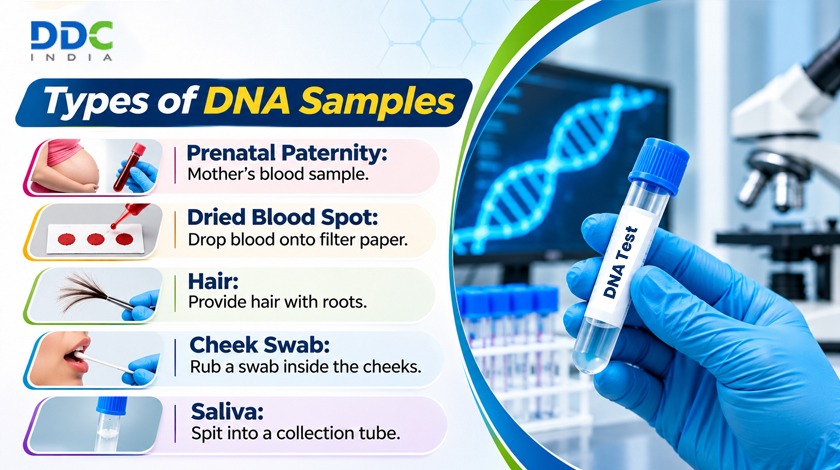
Saliva is one of the most popular sample types today, especially for ancestry kits and consumer genetic tests. You either spit into a collection tube or collect it with a special sponge.
Saliva contains cheek cells that shed naturally into your mouth, and these cells carry your DNA. The method is painless, quick, and easy to do at home.
Best for: Ancestry testing, health risk screening, wellness reports, and some clinical genetic tests.
Things to keep in mind: You should avoid eating, drinking, smoking, or chewing gum for about 30 minutes before collection. Food and drink can dilute the sample or introduce bacteria, which may lower quality. Saliva samples are also less suitable for very young babies, who may not be able to produce enough.
2. Buccal (Cheek) Swabs
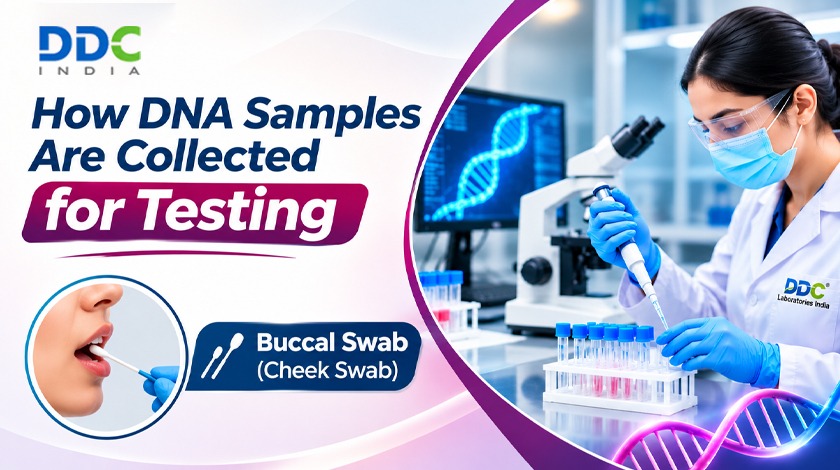
A buccal swab involves rubbing a soft cotton or foam-tipped swab against the inside of your cheek for a few seconds. This collects fresh DNA cells from the mouth lining.
Cheek swabs are the standard choice for paternity testing, relationship testing, and many diagnostic tests. They are gentle enough for newborns and children, and they do not require a needle or specialist.
Best for: Paternity and family relationship tests, ancestry tests, and testing infants.
Things to keep in mind: The swab must touch the cheek firmly enough to pick up cells, and it must not touch any other surface afterward. Most labs ask for two or more swabs per person to ensure enough DNA is collected.
3. Blood Samples
Blood is considered the gold standard for many medical DNA tests. A trained healthcare worker draws blood from a vein, usually in the arm. For newborn screening, a few drops are taken from the baby’s heel and placed on special absorbent paper.
DNA from blood comes from white blood cells, since mature red blood cells in humans do not have a nucleus. Blood provides a large amount of high-quality DNA, which makes it ideal for detailed or complex analysis.
Best for: Diagnosing genetic conditions, carrier screening, cancer-related genetic testing, pharmacogenetic testing, and chromosome analysis.
Things to keep in mind: It is more invasive than a swab, so it requires a clinic or laboratory visit. Some people feel anxious about needles, though the process is typically over in a few minutes.
4. Dried Blood Spots
A dried blood spot is a small drop of blood, often from a finger or heel prick, placed on filter paper to dry. This testing method is widely used for newborn screening programs around the world.
The paper can be stored and mailed easily, and the small volume makes it suitable for babies. It is a practical option when large blood draws are not possible.
Best for: Newborn screening and certain public health testing programs.
5. Hair Samples
Hair can be used for DNA testing, but only if the strand includes the root. The root, or follicle, contains cells with DNA. The shaft of the hair, which is the part you see, contains very little nuclear DNA.
Hair should be plucked rather than cut, since cutting leaves the root behind. Usually, several strands with visible roots are needed.
Best for: Situations where other samples are unavailable, and some forensic uses.
Things to keep in mind: Hair is less reliable than saliva or blood, and results can fail if the hair roots aren’t provided.
6. Prenatal Samples
DNA testing during pregnancy uses specialized procedures and sample types, such as:
- Maternal blood (cell-free DNA): A mother’s blood contains small fragments of DNA from the placenta. Non-invasive prenatal testing analyzes this to screen for conditions such as Down syndrome. It carries no direct procedural risk to the baby, but it is a screening test, not a diagnosis.
- Amniotic fluid: It is collected through an invasive process called amniocentesis. This test is generally performed between 15 and 20 weeks of pregnancy.
- Chorionic villus sampling (CVS): A small sample of placental tissue is taken, typically between 10 and 13 weeks. It offers earlier diagnostic testing.
Amniocentesis and CVS provide highly reliable diagnostic results, but these procedures carry a small risk of pregnancy loss.
7. Other Sample Types
Some less common samples include:
- Nails: Fingernail or toenail clippings may contain enough DNA for certain forensic tests, though quality varies.
- Semen and urine: Can be used in specific medical or legal situations.
- Bone marrow: Collected through a special procedure for diagnosing blood cancers or transplant matching.
- Stool: Used in some colorectal cancer screening tests that look for DNA changes shed from the bowel lining.
How to Choose the Right DNA Sample?
The best sample depends on your testing purpose. Here is a quick comparison:
| Purpose | Sample Type |
|---|---|
| Ancestry | Saliva or cheek swab |
| Paternity | Cheek swab |
| Medical Diagnosis | Blood or other clinically appropriate sample |
| Newborn Screening | Dried blood spot |
| Cancer Testing | Tissue or blood, depending on the test |
| Pregnancy | Maternal blood, amniotic fluid, or placental tissue |
If your test has been ordered by a doctor, follow the instructions you are given. If you are using a home kit, read the collection steps carefully, since small mistakes can affect results.
For everyday curiosity such as ancestry, a simple saliva or cheek swab is usually enough. For health decisions, a blood or tissue sample recommended by a doctor may be more appropriate, depending on the test.
Why Choose DDC Laboratories India for DNA Tests?
DDC Laboratories India is one of the reliable DNA testing laboratories in India, providing DNA reports for personal and official use. Our lab experts are rigorously trained, with years of expertise in DNA testing services. They also utilize advanced technology for DNA testing procedures designed to deliver accurate results. We have more than 250 sample collection centers across the globe, making the sample collection process convenient for individuals.
We provide DNA testing services for peace of mind, sponsored immigration, non-invasive prenatal paternity, cell line authentication, DNA profiling, discovery of ancestral past, and more.
Contact DDC Laboratories India
For more information or to book a DNA test, contact us:
Phone: +91 8010177771
WhatsApp: +91 9266615552

