
Have you lost touch with someone who might be your blood relative? Maybe you were adopted and want to find your birth parents, family history, or a family was separated years ago, and the truth got buried under old stories. Memories can only carry you so far, but your DNA holds answers to the hidden biological truths. DNA testing to find relatives lets you compare your genetic markers with a potential relative to confirm whether you are truly genetically related. This guide regarding DNA testing to find relatives explains how the process works so you can make informed decisions.
Also Read: Paternity DNA Test
Why People Look for Their Biological Relatives
There are many reasons someone might need to confirm a family connection later in life:
- Adoption: Adopted children, now grown, often want to locate their birth parents or biological siblings.
- Family Disputes: Inheritance and property cases frequently require proof of a blood relationship before a claim can move forward.
- Lost Contact: Migration, family conflict, or simply drifting apart over the decades can separate relatives who later want to reconnect.
- Missing Parents: When a father or mother has passed away or cannot be located, you may still be able to prove your place in the family through other relatives.
- Parentage Uncertainty: Some people grow up with doubts about their biological father or mother and want a clear, private answer.
How Does DNA Testing Help You Find Relatives?
A person inherits half of their DNA from their mother and half from their father. Those parents inherited their DNA from their own parents, and so on, back through every generation. This means close relatives share noticeably more genetic markers with each other than strangers do.
When the lab experts compare the DNA samples, they analyze the specific markers, which are found to be similar only in biologically related individuals. If the markers do not match, the biological link is ruled out. The lab experts then turn this comparison into an accurate genetic percentage, so you get a straightforward answer instead of a guess.
Types of DNA Tests That Help You Find Relatives
Different family situations call for different tests. Here are the main options available in India.
- Siblingship DNA Test – This test checks whether two people share one or both biological parents. It is useful when you suspect you have a half-brother or half-sister, or when you want to confirm a full sibling relationship, but the parents are not available to test directly.
- Grandparentage DNA Test – When a parent has passed away or cannot be reached, this test offers another path forward. It compares a grandchild’s DNA with a grandparent’s DNA to confirm the family link, which is often important in inheritance and custody matters.
- Relationship Reconstruction DNA Test – This test is built for more complicated cases. If the person you need to prove a connection to is missing or has died, the lab can test other relatives instead, such as an uncle, aunt, or cousin, to reconstruct the family relationship.
- Paternal Lineage Test (Y-STR) – This test compares the Y chromosome, which passes from father to son almost unchanged. It can show whether two men share the same paternal line, which makes it useful for confirming a connection between brothers, cousins, or other male relatives separated by years or even generations.
- Maternal Relative Test (mtDNA) – This test looks at mitochondrial DNA, which a mother passes down to all her children. Both men and women can take this test to check whether they share the same maternal line, making it a helpful option when you are trying to confirm a connection through grandmothers, aunts, or distant cousins on the mother’s side.
Also Read: Ancestry DNA Test India
Understanding the DNA Testing Process
Getting tested is far simpler than most people expect, and there are no needles involved.
Step 1 – Schedule Appointment: Call the lab experts and schedule a DNA test after discussing your needs.
Step 2 – DNA Sample Collection: A trained lab professional collects a quick, painless cheek swab from you and the relative you want to compare your DNA with. You can also order a kit online and collect the sample at home.
Step 3 – DNA Comparison: Your sample is compared against the other person’s sample using specific genetic markers.
Step 4 – Final Report: Within a few weeks, you will receive a confidential report stating clearly whether a biological relationship exists.
Why Choose DDC Laboratories India for Relative DNA Tests?
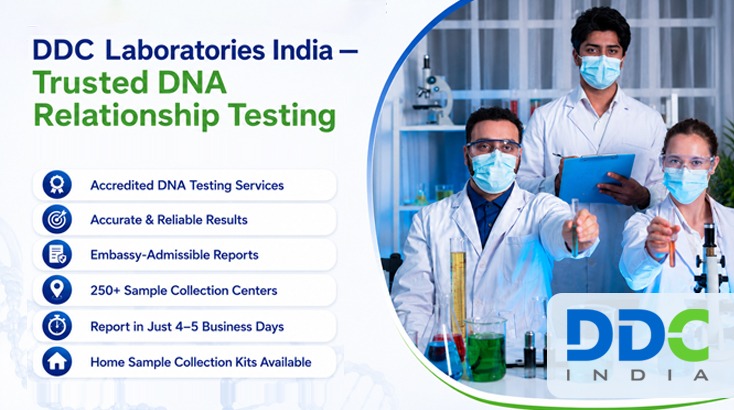
We, at DDC Laboratories India, provide accredited and reliable DNA testing services for personal as well as official reasons. Our testing lab holds accreditations from esteemed organizations like NATA, MOJ, IRCC, and AABB. With such accreditations, our DNA reports are legally admissible in international embassies like the United States, the United Kingdom, Canada, Australia, and others.
Besides, we also provide DNA tests for peace of mind, non-invasive prenatal paternity, cell line authentication, discovery of ancestral past, and more. With over 250+ sample collection centers worldwide, it’s easier to find one of our testing facilities near your location.
For more information or to book DNA testing to find relatives, call us at +91 8010177771. Alternatively, you can also send a message on WhatsApp at +91 9266615552.
Read More: Legal Procedures For a DNA Test in India
Frequently Asked Questions
Q1. How accurate is DNA testing in finding relatives?
A DNA test to find relatives provides an accuracy rate of 99.99%, which is similar to all other forms of DNA testing services.
Q2. What’s the turnaround time for the DNA report?
DDC Laboratories India delivers the final report within 4-5 business days.
Q3. Can I order a DNA test kit and collect the sample at home?
Yes. At DDC Laboratories India, we also provide online DNA test kits.
Q4. Can a paternal lineage test connect me to male relatives I’ve never met?
Yes. Since the Y chromosome passes almost unchanged from father to son, this test can confirm whether two men share the same paternal line, even across distant generations.
Q5. Is there an age requirement for taking a relative DNA test?
There’s no age limit. For minors, a parent or legal guardian typically needs to provide consent and be present for the sample collection.

